
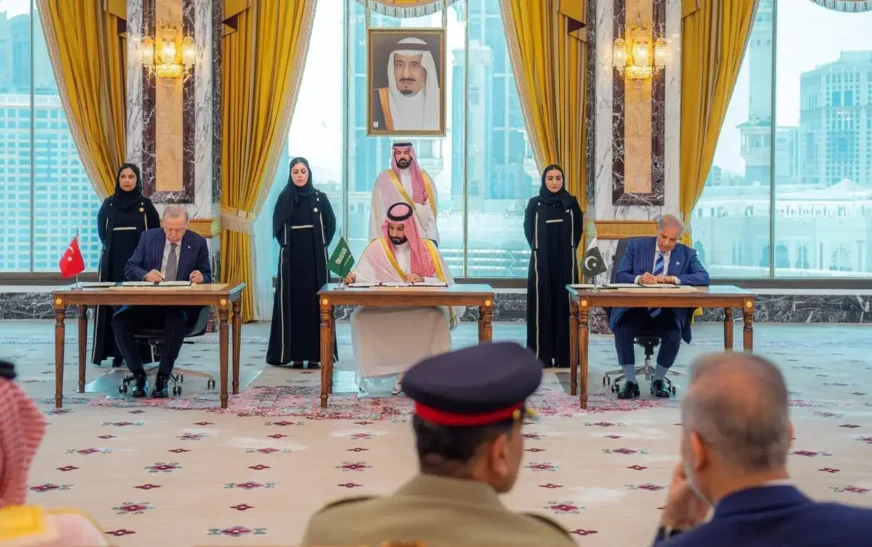
The full text of the Mecca Defence Pact signed by Pakistan, Türkiye and Saudi Arabia on August 7, 2026, has emerged, revealing the conditions under which the three countries will assist one another in the event of an external armed attack.
According to an exclusive report published by Middle East Eye on October 20, the Turkish government submitted the agreement to parliament on Tuesday.
The 16-article pact establishes a framework for collective defence, military training, defence industry cooperation, intelligence sharing and coordination on national security matters.
Under the agreement, an external armed attack against any one of the three countries will be considered an attack against all three.
However, the treaty does not identify any particular country or region as a threat. It emphasises respect for sovereignty, territorial integrity, internationally recognised borders, non-interference in internal affairs and compliance with international law.
Collective Defence: Does an Attack Trigger an Automatic Military Response?
Article 1 commits Pakistan, Türkiye and Saudi Arabia to protecting one another’s independence, sovereignty, territorial integrity and internationally recognised borders.
It states that if any member’s sovereignty, territorial integrity or recognised borders are threatened or endangered, the parties will use all necessary means to eliminate the threat.
Article 2 goes further, declaring that an externally originating armed attack against any member will be regarded as an attack against all three.
If one country faces an armed attack or military aggression by another country or group of countries, the remaining members must provide immediate assistance.
However, the agreement does not require an automatic military response in every situation.
Instead, the nature and extent of assistance will be determined through an objective assessment of the affected country’s needs and the resources available to the other members.
Such assistance may include military capabilities and resources, in accordance with the right of self-defence recognised under Article 51 of the United Nations Charter.
Counterterrorism Cooperation Included in the Pact
Article 5 specifically addresses cooperation against terrorism.
Under this provision, Pakistan, Türkiye and Saudi Arabia will strengthen their existing cooperation and joint efforts against terrorism in all its forms, particularly activities that threaten regional and international peace and security.
The agreement also provides for cooperation at the operational level.
However, the text does not identify any particular terrorist organisation or announce a specific joint counterterrorism operation.
No Withdrawal During the First 10 Years
One of the agreement’s most significant provisions concerns its duration and withdrawal conditions.
Under Article 16, the treaty will remain in force indefinitely once it formally enters into effect.
No member country will be permitted to withdraw during the first 10 years following its entry into force.
After that period, a country wishing to leave must notify the other members in writing through diplomatic channels at least three months in advance.
Importantly, withdrawal or termination will not affect ongoing activities or projects agreed upon before the date of departure.
Obligations concerning the protection of classified information and prevention of its disclosure will also remain binding after a country leaves the agreement.
Pakistan to Provide the First Secretary-General
Article 8 provides for the establishment of a Strategic Political and Defence Committee comprising the foreign ministers, defence ministers and chiefs of general staff of Pakistan, Türkiye and Saudi Arabia.
The committee will provide strategic direction for collective defence, strengthen security cooperation and address obstacles to implementing the agreement.
It will meet twice annually, with the three countries taking turns to host its meetings.
The leaders of the member countries may also meet once a year if considered necessary.
A permanent secretariat will be established in Saudi Arabia to support the committee.
The secretariat will be headed by a secretary-general appointed for a three-year term, with the position rotating among the three founding members.
The agreement explicitly states that the first secretary-general will be a Pakistani national.
The committee may establish subcommittees and negotiate additional agreements or protocols to implement the treaty.
Its creation will not interfere with the work of existing military cooperation committees among the three countries.
Can Other Countries Join the Defence Alliance?
The agreement allows for the possibility of additional countries joining the pact.
However, Article 8 specifies that the procedures and principles governing the admission of new members must be determined and approved by consensus among Pakistan, Türkiye and Saudi Arabia.
The treaty does not name any additional country as an approved member.
Defence Industry Cooperation and Joint Production
Article 3 calls for closer cooperation in defence, security and the defence industry, including stronger relations among the armed forces.
Article 7 provides a detailed framework for technological and industrial cooperation.
The three countries will encourage joint defence production, technology sharing, collaborative research and development, and innovation in specialised military technologies.
They will also support personnel training through the exchange of experts and share knowledge and experience in defence research, industrial development and innovation.
Other areas of cooperation may be introduced through mutual agreement.
Joint Military Exercises and Personnel Exchanges
Article 6 calls for military personnel exchanges, joint training programmes, exercises and other agreed activities during both peacetime and wartime.
The aim is to improve military readiness, strengthen defence capabilities and enable the armed forces of the three countries to operate more effectively together.
Article 4 also requires regular consultations on international security issues.
The members will cooperate in developing individual and collective measures based on shared assessments of threats to their national security and vital interests.
Intelligence Sharing and Classified Information
Article 9 establishes a framework for intelligence sharing through secure channels agreed upon by the three countries.
Such exchanges must comply with requirements relating to information security, data protection and confidentiality.
Article 13 introduces additional safeguards for classified information and documents.
Under these provisions, classified material obtained through the agreement cannot be disclosed to countries, companies or individuals outside the participating states.
Access will be restricted to authorised personnel who have an operational need for the information and hold the appropriate security clearance.
These confidentiality obligations will continue even after a member withdraws or the agreement is terminated.
Weapons, Ammunition and Logistical Assistance
Article 10 addresses logistical support during peacetime, wartime and other emergencies.
The three countries will provide one another with support that may include weapons, ammunition, fuel, spare parts and other military equipment.
However, such assistance will depend on the availability and compatibility of logistical support services.
Legal Obligations and Existing International Agreements
Article 11 recognises the pact as a legal basis for implementing its provisions, subject to international law and the domestic laws of the participating countries.
The members may propose additional legal measures where necessary.
Article 12 makes clear that the new agreement will not affect the rights and obligations arising from international treaties already concluded by the three countries.
This provision is particularly relevant to Türkiye, which is also a member of NATO.
Article 14 states that disputes over the interpretation or implementation of the agreement will be resolved peacefully through consultations and discussions.
Under Article 15, amendments can be made only through consultations and unanimous agreement among the three founding members.
When Will the Mecca Defence Pact Enter Into Force?
Although the agreement was signed in Mecca on August 7, 2026, its formal entry into force is subject to ratification procedures in all three countries.
Article 16 states that the treaty will become legally effective once the final instrument of ratification has been deposited with the secretariat of the Strategic Political and Defence Committee.
The agreement has been prepared in three original versions: Turkish, Arabic and English.
All three texts are considered equally authentic. However, if differences arise in their interpretation, the English version will prevail.
What Does the Agreement Mean for the Three Countries?
The Mecca Defence Pact represents an effort to place the existing military and security relationships between Pakistan, Türkiye and Saudi Arabia within a formal, long-term collective defence framework.
Its provisions extend beyond responding to external attacks, covering counterterrorism cooperation, defence manufacturing, military training, intelligence sharing, logistical assistance and regular strategic consultations.
The treaty also establishes a permanent institutional structure, creates a mechanism for admitting additional members and imposes a minimum 10-year commitment before withdrawal becomes possible.
While the agreement establishes an obligation to provide immediate assistance in the event of an external armed attack, it leaves the precise nature and scale of military support to be determined according to the circumstances and available capabilities.
The pact’s practical implementation will depend on the completion of national ratification procedures and the subsequent decisions taken by the three participating governments.