

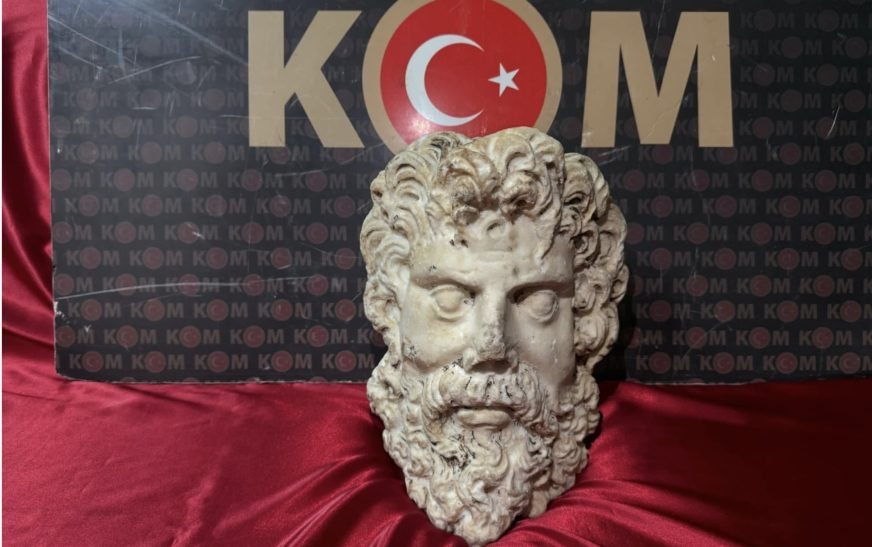
İZMİR, October 21, 2026: Turkish police have recovered an ancient marble sculpture believed to depict the head of Zeus during an operation against the illegal trafficking of historical artefacts in the western city of İzmir.
The sculpture, estimated to be approximately 2,000 years old, is believed to date from the Roman period.
According to Türkiye’s Demirören News Agency (DHA), three suspects were detained in connection with the discovery.
The operation took place in İzmir’s Konak district on October 20, while details of the seizure were reported on Wednesday, October 21.
The investigation was conducted under the coordination of the İzmir Chief Public Prosecutor’s Office.
Officers from police units responsible for combating smuggling and gathering intelligence participated in the operation.
Ancient Marble Sculpture Recovered
Turkish authorities said the marble head was discovered during an investigation into the suspected illegal trade in historical objects.
Police conducted an operation at an address identified during their investigation and recovered the sculpture.
Preliminary assessments indicated that the artefact belonged to the Roman period and was approximately two millennia old.
The sculpture is believed to represent Zeus, a major deity in ancient Greek mythology who was associated with the sky, thunder and kingship.
Zeus was also widely represented in art and religious traditions during the Roman period, when Greek mythology continued to influence sculpture and architecture.
Authorities have not publicly established the sculpture’s precise original location or archaeological context.
Three Suspects Taken into Custody
Following the recovery, police detained three individuals suspected of involvement in activities that may violate Türkiye’s cultural heritage protection laws.
The suspects were taken into custody under an investigation involving alleged violations of the Law on the Protection of Cultural and Natural Assets.
The legislation, known as Law No. 2863, establishes protections for historical objects and archaeological heritage in Türkiye.
Authorities determined that the recovered sculpture qualified as a cultural asset requiring legal protection under the law.
The publicly available reports did not establish whether the suspects had been formally charged or provide details of any subsequent court proceedings.
The investigation remains a matter for the relevant judicial authorities.
Türkiye’s Rich Archaeological Heritage
Türkiye is home to numerous archaeological sites associated with ancient Greek, Roman, Byzantine and other civilisations.
Western Türkiye, including the wider İzmir region, contains important historical settlements that played major roles in the ancient Mediterranean world.
The region’s archaeological heritage includes temples, theatres, sculptures, inscriptions and other objects that provide evidence of its cultural and political history.
Ancient marble sculptures are particularly important to researchers because they can offer information about religious practices, artistic traditions and the communities that produced them.
However, when archaeological objects are removed from their original locations without proper documentation, valuable information about their historical context can be lost.
This is one reason why the protection of archaeological sites and the prevention of illicit artefact trafficking remain important concerns for cultural heritage authorities.
Efforts to Prevent Cultural Property Smuggling
Turkish authorities regularly investigate suspected violations of laws designed to protect historical and archaeological material.
These investigations can involve police intelligence units, prosecutors and specialists responsible for determining whether recovered objects are protected cultural property.
In the İzmir case, officials have confirmed the recovery of the sculpture and the detention of three suspects.
However, the reports available so far do not identify the object’s original archaeological site, provide an estimated market value or establish whether it had been prepared for sale abroad.
Such details would require further findings from investigators or cultural heritage specialists.
Investigation Continues
The discovery highlights the importance of safeguarding archaeological objects and preventing their unauthorised removal or trade.
The recovered marble head may provide useful historical information if specialists are able to establish its origin and examine its artistic characteristics.
For now, the confirmed developments are the seizure of the approximately 2,000-year-old sculpture in Konak and the detention of three suspects.
Further information about the artefact’s provenance and the outcome of the investigation will depend on official findings released by Turkish authorities.