
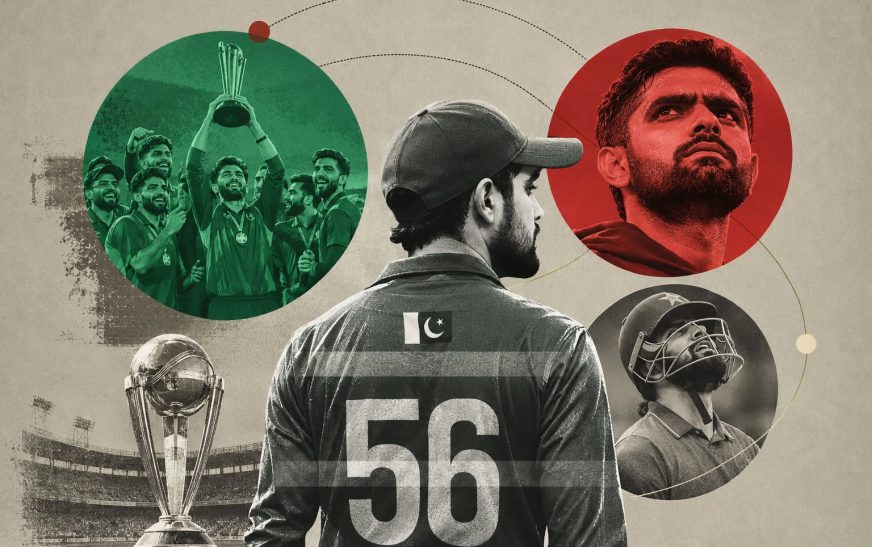
Pakistan’s home dominance has reached another milestone with the side lifting the ODI tri-series trophy, beating Sri Lanka, in an intense game of cricket, before a packed, boisterous crowd of Gaddafi Stadium. The blockbuster tri-series, which marked England’s ODI return in Pakistan for the first time since 2005, was meant to be a significant opportunity for the three teams to prepare themselves for the upcoming ODI World Cup scheduled in October 2027 in South Africa, with less than a year left. Pakistan winning the ODI tri-series provides them an encouraging foundation in analyzing their prospects for the upcoming World Cup, but the real measure of the victory lies in how Pakistan can pave the way of greater consistency for them. Thus, the bigger challenge for Pakistan lies in formulating tactics and combination which can be translated into efficacious World Cup campaign, leaving no ambiguity over roles, strategies and squad it intends to carry in the World Cup.
Pakistan’s batting turmoil
Pakistan’s batting credentials have always been skeptical, as a team, and it has further plumbed the depth, even by its own standards in recent times. Pakistan went on to be bowled out for 110 to chase 326 against the same opposition, all in a span of just four days. For a team capable of producing such dramatic turnarounds, the anticipation of its World Cup preparation becomes even harder. But Pakistan has always lived up to that expectation, and unfortunately, it hasn’t been paying off lately.
Apart from that final, which has been the only instance in this tri-nation series for Pakistan, where the individual brilliance of batters was complemented by collective batting performance, Pakistan’s journey to final, has largely, resulted from the individual batting show, saving Pakistan’s day. Despite the fact that Pakistan in this series, has batted on surfaces that allowed batters to enjoy the favorable conditions, Pakistan while batting first, has never touched down the 350 mark in this tournament. The three times they batted first, they were all out on 305 against Sri Lanka, 302 for 9 against England, and 110 for all out against Sri Lanka. On one occasion, where England asked them to chase 242 , they were 9 gone for 154 at one stage, before Shadab Khan miraculously built the highest 10th wicket partnership of 89 runs with Haris Rauf, in a successful ODI chase. Moreover, Saad Baig, who was playing his debut international series, turned out to be Pakistan’s leading run-scorer of the tournament, scoring 185 at an average of 37 , and also one of the most promising finds of the series for Pakistan. Pavan Rathnayake who had a relentless series, sits on the top, with 427 runs at the average of 106.75.
Faltering top order
Pakistan’s horrendous batting display largely stemmed from the lousy form of the top order. Almost in each game, two of the three top order batters departed early in the powerplay. Pakistan were 2 for 32 in 5.5 overs against Sri Lanka, losing both their openers, 2 for 31 against England in 5.5 overs , 3 for 31 in 6.5 overs, losing all of their top 3 against England and 2 for 23 in 6.2 overs against Sri Lanka, in a game where they were bowled out on 110 . Even in the final against Sri Lanka, Pakistan couldn’t resolve their top order’s struggle as they lost 2 quick wickets in 3.3 overs , while chasing 326 . The innings was then consolidated by a spectacular stand of 149 runs between Fakhar Zaman and Saad Baig.
Despite Pakistan’s right course of direction and ingredients in the middle order, the stark contrast has emerged in its preparation of the ODI World Cup, where it has moved from one of the formidable top 3 in 2023 to struggling to find the right answers for the same department ahead of the 2027 World Cup. Though Fakhar Zaman’s match-winning hundred has mitigated the concerns to some extent, the worrisome part stays with the continuity of poor spell of runs from the other end. The inauspicious impression has largely proliferated from Saim’s protracted run of poor form, who has been provided the extended backing from the management, only to fluff every time. Team management’s confidence on Saim Ayub speaks volume as Pakistan while announcing the squad, didn’t have any backup opener. Eventually, they had to oust Saim Ayub to get the likes of Maaz Sadaqat and then Sahibzada Farhan to abate the crisis. Saim Ayub scored 21 runs in 3 innings with a highest of 8 runs, whereas in the 2 outings Maaz Sadaqat got, he only managed to get 13 runs, with 8 his most in one innings. With the time ticking on, Pakistan needs a substantiated answer to cover this lacuna in the opening pair.
Babar’s waning reputation
The most accentuated portion of batting struggles belong to Pakistan’s one of the most illustrious batter in recent times, Babar Azam, who seems to have lost his flare all along with his evolution. Once the bedrock of Pakistan’s ODI team, Babar Azam’s journey has nosedived from his standard heights, unable to carry along the level of expectations usually associated with great players. Since Babar’s much-anticipated 20th ODI hundred which came after a protracted struggle, he has played 9 innings to score 277 runs, at an average of 30.77, with an alarming strike-rate of 68.40 , which has been his gravest concerns. This tri-series was a golden opportunity for Babar to resuscitate his successful ODI template, but he ended piling up the waves of criticism, questioning the validity of his place in the World Cup. The Pakistan’s Test skipper in his batting contributions for Pakistan in this tri-series, sits far below the likes of Arafat Minhas and Hassan Nawaz, scoring 118 , at a below par average of 23.60 and the strike rate of 74.21 .
An in-form Babar would have exactly been the proponent Pakistan needed for its World Cup campaign in South Africa, but it’s getting far away from reality and there are time constraints to make the call. For Babar Azam, with no ODI series scheduled in the near time, it has to be either the Test series against Sri Lanka, or the Quaid e Azam Trophy, but it has to be plenty of runs for Babar Azam to regain his form to deserve his place in the ODI side.
Emergence of young stars
The most promising feature for Pakistan in this tri-series has been the pivotal contributions of youngsters, Saad Baig, Hassan Nawaz and Arafat Minhas, all across the tournament. The team management insisting to blend the youngsters across formats has really given Pakistan Cricket a new taste, which augured well for the direction of this team. Arafat Minhas, who bagged his second player of the series award in the ODIs showed the true benchmark of all-round capabilities, winning games for Pakistan with both, the bat and bowl. These youngsters have shown the skills and mental resilience to dream the ticket for representing Pakistan in the World Cup. Its high time Pakistan should start investing in youngsters for their talent and shouldn’t compromise them only for the experience of the senior players, so that the received wisdom could be buried.
Pakistan’s bowling might
Pakistan’s bowling has been its greatest strength in this tri-series which primarily is the reason for lifting the trophy. The bowlers were able to defend below par totals, with skipper Shaheen Afridi and Arafat Minhas leading the ranks. Both grabbed 10 and 9 wickets respectively, at the average 21.62 and 23.22 . Shaheen Afridi was the most lethal among the pace battery of Pakistan, getting wickets with both the new and the old ball. Though, Haris Rauf was decent with the old ball, Naseem Shah is struggling to maintain his fitness. With the World Cup in South Africa, Pakistan’s concern lies in finding a utility seamer as their fourth pacer in the XI. Pakistan at the moment has been relying on Faheem Ashraf to do the job, who hasn’t completed his quota of complete overs in any of the 3 games, he played. Razaullah, who has been kept as a backup for pace bowling could become handy with his raw pace, but he needs to add some precision to his bowling. Moreover, with the suitable conditions for pacers in South Africa, the effectiveness of specialist spinner also becomes moot point. Pakistan in the recent series, haven’t given a go to Abrar Ahmed or Sufyan Muqeem, who was later dropped from the side and persisted with the likes of Arafat Minhas and Shadab Khan, Salman Ali Agha and Saim Ayub.
The predicament for Pakistan lies in finding the balanced combination, with a specified role to take responsibility in the upcoming World Cup and to aggravate it further, they need to find a better way to play with Shadab Khan, Arafat Minhas and Faheem Ashraf to maximize their batting options. Though, Mike Hesson’s theory purportedly lies against playing specialists, his accommodation of finding the right combination of all-rounders has to be seen in this World Cup.
Perhaps, Pakistan isn’t the side which has relied on finding the right answers to all the questions simultaneously, but they are compelled not to miss the non-negotiable. Their unpredictability can win those games, but it has to be replaced with consistent performance and pragmatic solutions to dream for ending the World Cup drought. The tri-series has depicted what this side could become, but the translation needs answers, long before the time passes. Pakistan’s road to World Cup success will depend on how well-equipped they are to convert the individual contributions into sustained collective brilliance, ensuring that all its departments can deliver together even against the strongest opposition. Pakistan’s history always reminds us that it guarantees no success, when the ultimate challenge of World Cup arrives. Could this time be any different? Only time will tell and so does Pakistan’s preparatory coursework.