
Libya’s eastern-based parliament has approved a maritime boundary agreement with Türkiye, reversing its earlier opposition to a pact that has remained at the centre of regional disputes over energy resources, territorial rights and military influence.
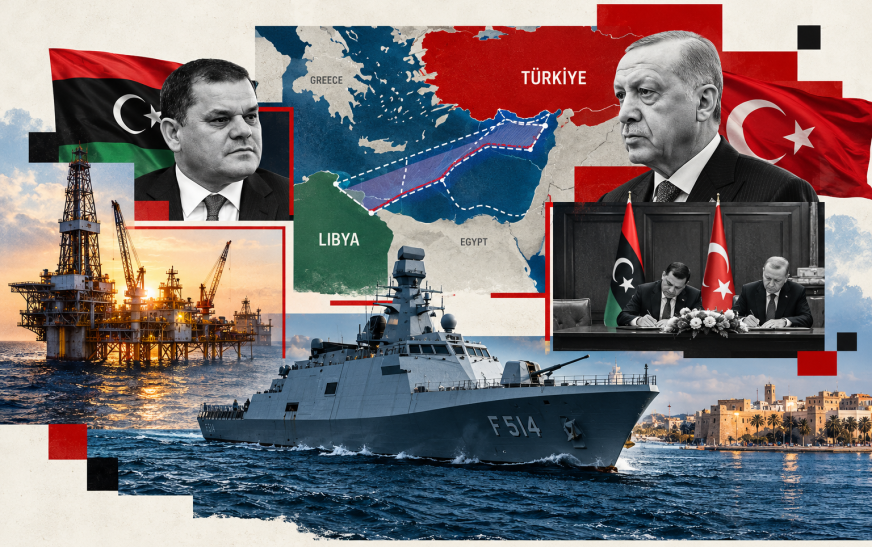
The House of Representatives, based in Tobruk, voted unanimously on Tuesday to endorse the agreement originally signed in November 2019 between Turkish President Recep Tayyip Erdoğan and Libya’s then-prime minister Fayez al-Sarraj, who headed the internationally recognised government in Tripoli.
The decision represents a significant diplomatic development for Ankara, which has spent recent years improving relations with eastern Libya despite previously supporting the rival administration in Tripoli against forces loyal to military commander Khalifa Haftar.
Why the Agreement Matters
The 2019 memorandum establishes maritime boundaries between Türkiye and Libya across the eastern Mediterranean, potentially strengthening Ankara’s claims over waters believed to contain valuable natural gas reserves.
Türkiye maintains that the agreement protects the maritime rights of both countries and follows principles of fairness under international law.
However, several Mediterranean countries dispute the boundaries, arguing that the agreement overlooks the maritime entitlements of Greek islands and overlaps with areas claimed by neighbouring states.
The controversy has intensified following eastern Libya’s decision to recognise the arrangement, bringing the country’s rival political authorities into agreement on a major foreign policy issue.
EU and Egypt Reject the Decision
Egypt’s Foreign Ministry rejected the parliamentary endorsement, arguing that the agreement infringes upon Egyptian sovereign rights within its exclusive economic zone and continental shelf.
Cairo maintained that the decision would have no legal consequences for Egypt.
The European Union also opposed the move, with European Council President Antonio Costa and European Commission President Ursula von der Leyen expressing concern over its implications for the maritime rights of other countries.
The EU leadership reaffirmed support for Greece and Cyprus, both of which have challenged Türkiye’s maritime claims.
Greece argues that the agreement disregards the maritime zones associated with islands including Crete, Rhodes and Karpathos.
Athens has raised the matter at the United Nations Security Council and indicated that it will pursue measures to defend its claimed maritime rights.
Israel has also criticised the parliamentary decision.
Türkiye Defends Legality of Pact
Turkish Foreign Minister Hakan Fidan rejected the objections, describing the agreement as legally valid and consistent with international principles.
Ankara argues that the memorandum is already in force and that the latest parliamentary endorsement reinforces the legitimacy of the maritime arrangement.
Türkiye is not a party to the United Nations Convention on the Law of the Sea, a treaty frequently cited by Greece and European institutions in their objections.
The dispute also has implications for regional infrastructure, including a proposed underwater electricity connection linking Greece, Cyprus and eventually Israel.
Analysts say competing maritime claims could complicate energy exploration, electricity infrastructure and naval operations in the Mediterranean.
Why Eastern Libya Changed Position
Eastern Libya’s approval follows a gradual improvement in relations between Ankara and Haftar’s military establishment.
Türkiye previously provided military assistance to the Tripoli government during Haftar’s unsuccessful campaign to capture the capital in 2019 and 2020.
More recently, however, Turkish officials have expanded diplomatic and defence contacts with eastern Libyan authorities.
The election of Al-Salhin Abdelnabi al-Obeidi as parliamentary speaker earlier this month also marked a political shift. Al-Obeidi previously headed the Libyan-Turkish parliamentary friendship committee.
Political analysts believe Ankara’s growing influence across Libya’s rival power centres played an important role in securing the parliamentary endorsement.
Nevertheless, the agreement does not resolve Libya’s wider political divisions over control of state institutions, military forces, public finances and elections.
What Happens Next?
Although both eastern and western Libyan authorities now support the maritime agreement, its implementation could face legal, diplomatic and operational obstacles.
Future exploration activities and maritime operations in disputed waters may provoke further objections from Greece, Egypt and other regional governments.
Security analysts have also warned that competing naval activities could increase the risk of confrontation if either side attempts to enforce its maritime claims.
For Türkiye, the endorsement represents a diplomatic gain in its efforts to expand influence across the eastern Mediterranean.
For its regional opponents, however, the decision raises renewed concerns over maritime sovereignty, energy competition and the future balance of power in one of the world’s most strategically important waterways.